
Plans are funny things. We put such time and effort into ensuring things go smoothly: we check routes, make reservations, buy tickets. We make promises to our future selves that if we are organised enough life will behave accordingly. But the best-laid plans of mice and men, as they say, often go awry.
After my initial stop to meet Eric, my next flight was to take me to see my old childhood friend, Logan. He is another friend whom the internet put me in contact with, far before the days of Substack, back when OpenDiary was a thing and goth kids poured our hearts out to blank screens with carefully curated HTML pop-ups. We were teenagers then, building strange little digital versions of ourselves and throwing them out into the world in the hope that someone, somewhere, might recognise us.
Somehow, more than twenty years later, some of those people are still here. However, sadly, a car-based emergency meant Logan couldn’t get to the airport to catch his flight. I therefore ended up with two days free. Not an issue at home, where there are endless chores to keep me occupied (there is, after all, always laundry to fold), but significantly more problematic in another country on my own.
I wasn’t due to meet artist Steven Fain until Thursday evening but, when he found out about my change in plans, he came to my rescue. He couldn’t fathom the idea of leaving me alone without someone for company. This, I would discover, was very Steven.
I have to admit, as I waited in my hotel, I was anxious. Until then, my adventures to meet Substackers had been relatively short meetings. Enough time to discover whether the person you have built in your head bears any resemblance to the flesh-and-blood human who eventually walks through the door. Steven and I had something rather different planned.
We were going to spend the best part of two weeks together, travelling and working on upcoming projects. That’s a long time to spend with someone you’ve never met. Long enough for politeness to wear thin and irritating habits to become clear. Now, while I was confident that Steven does not harbour an enthusiasm for competitive taxidermy, I did not know if he chewed with his mouth open. And, as a select few friends enjoyed reminding me, there was every chance he could be an axe murderer.
So, when he knocked on the door to collect me, my heart was in my throat. Despite having never met him, he was almost exactly as I expected. He was no longer sporting the Liberty spikes of his youth, but the punk essence was still there. Standing at over six feet tall, with dark tattoos creeping across his skin, he could be intimidating. But he wasn’t. There was something immediately gentle about him. Steven Fain radiated the kind of warmth that can only be formed by having faced open hostility in your life. The particular softness of someone who knows exactly what cruelty looks like and has made a conscious decision not to add to it.
He smiled and we laughed and hugged at the absurdity of our meeting — I’d flown three and a half thousand miles to meet him and neither of us knew what to say.
There is something wonderfully ridiculous about knowing someone before you know them. We already knew each other’s work, opinions, stories, jokes. We had collaborated and talked and shared pieces of ourselves through screens. Yet suddenly there was a body attached to all those words, standing awkwardly in a hotel room. Thankfully, the awkwardness didn’t last long. Steven was a man of endless stories and I listened like a child.
Over our time together, he talked about life with me using an unending number of sandwich analogies. I’m not entirely sure when sandwiches became his preferred philosophical framework, but apparently almost every problem facing humanity can, with sufficient imagination, be explained using bread.
Somewhere amongst the sandwiches, I asked him why he refused to charge what other artists charged. My walls at home are weighed down with hundreds of paintings, prints and sketches — some commissioned, some bought on humid streets on holiday, and some from galleries I had no business being in. I’ve collected art since I was old enough to recognise what art meant. Yet I’d never met someone who refused to charge for their skill the way Steven did.
He claimed his rally against capitalism was a manifestation of his punk spirit, but I think there was more to it than that. A man who was once homeless values things very differently from someone who has never wondered where he’ll sleep or where his next meal is coming from. When you have experienced having nothing perhaps money stops being quite such a convincing measure of what something is worth. Food has value, shelter has value, but the rest starts to look suspiciously like numbers we all agreed to believe in. Perhaps the sandwich analogies made sense after all.
As I got to know him, I saw he was a father before all things. We sat sipping coffee each morning, swapping stories and suggesting artistic ventures. Yet, amongst all of it, his children were never far from the conversation. It became increasingly clear that this was the longest he’d spent away from them. There were phone calls and stories and little references threaded through everything. This “old punk” — as he insisted on being branded — hadn’t fully rejected social norms after all.
In fact, there was something almost amusingly contradictory about him. This anti-authoritarian, anti-capitalist punk was also the epitome of wholesome, traditional American family values — the values that America itself may have forgotten somewhere along the way. Work hard. Look after your family. Feed people. Help your neighbours. Make yourself useful. Don’t leave someone stranded when you have the ability to help. Perhaps that in itself was his brand of non-conformity.
I was still pondering this the next day when we were having lunch. We walked outside into the baking heat and almost immediately we were stopped by a woman desperately looking for someone to change her daughter’s flat tyre.
Steven is physically incapable of seeing a soul in need without stopping to assist. He is a man who had decided a long time ago that if someone else could do something, it couldn’t be that hard to learn. He wasn’t the only person I knew who could change a tyre. There was nothing particularly remarkable about the mechanics of what he was doing. But somehow this felt more significant.
As he lay there on the ground, in the heat and dirt, working on the car of a complete stranger, I realised that, until then, I’d misunderstood what he meant when he talked about DIY. I thought I understood it. DIY was creating independent zines. It was publishing books yourself rather than waiting for someone to give you permission. It was recording local music, making art, printing things by hand. It was train-hopping as a kid. It was punk in the way I understood punk: stapled paper, photocopiers, safety pins and a refusal to ask authority whether you were allowed to make something.
Suddenly, I realised it meant everything. It meant learning about make-up so he knew what to buy for his daughter. It meant fixing his own car when he was driven off the road. It meant learning whatever skill the people he loved happened to need. Steven relied on no one. But there was a contradiction in that too, because while he had built a life around not needing other people to rescue him, he seemed determined to make sure other people could rely on him.
On our last night, Steven spent most of the day in the kitchen while I packed. There was something strangely domestic about the whole thing. Me upstairs attempting to compress two weeks of America back into a suitcase; him downstairs quietly making dinner.
When I eventually came down, his shorts were covered in flour from the fresh pasta he’d made. I joked that he’d make a great Trad Wife, but he didn’t know the reference. Of course he didn’t, memes and trends and influencers were no part of his life. I looked at this man — this artist, philosopher, mechanic, father — and added chef to his ever-expanding list of talents. He was so much more than he seemed.
When it came time to leave, the inverted commas around “old punk” had faded from my mind. I had arrived thinking punk was something Steven had carried with him from his youth: the remnants of Liberty spikes and train tracks, photocopied zines and teenage rebellion. Something you eventually soften around the edges and look back on affectionately. I was wrong. For Steven, punk was never the hair. It was the decision to build a community when the existing one didn’t have room for you. It was building a life with your own hands.
And somewhere over those two weeks, this anti-authoritarian, anti-commercialist, non-conforming, build-your-own-life kinda man had changed the way I thought about my own. Maybe my best-laid plans had gone awry. I think they were supposed to. I’m proud to say that I have a short story being published by Steven under his new publishing company Paper Gun Press and that we have a few other projects that will be releasing out over the coming months. But mostly, I’m proud to have him in my life.
P.S. He does not chew with his mouth open.
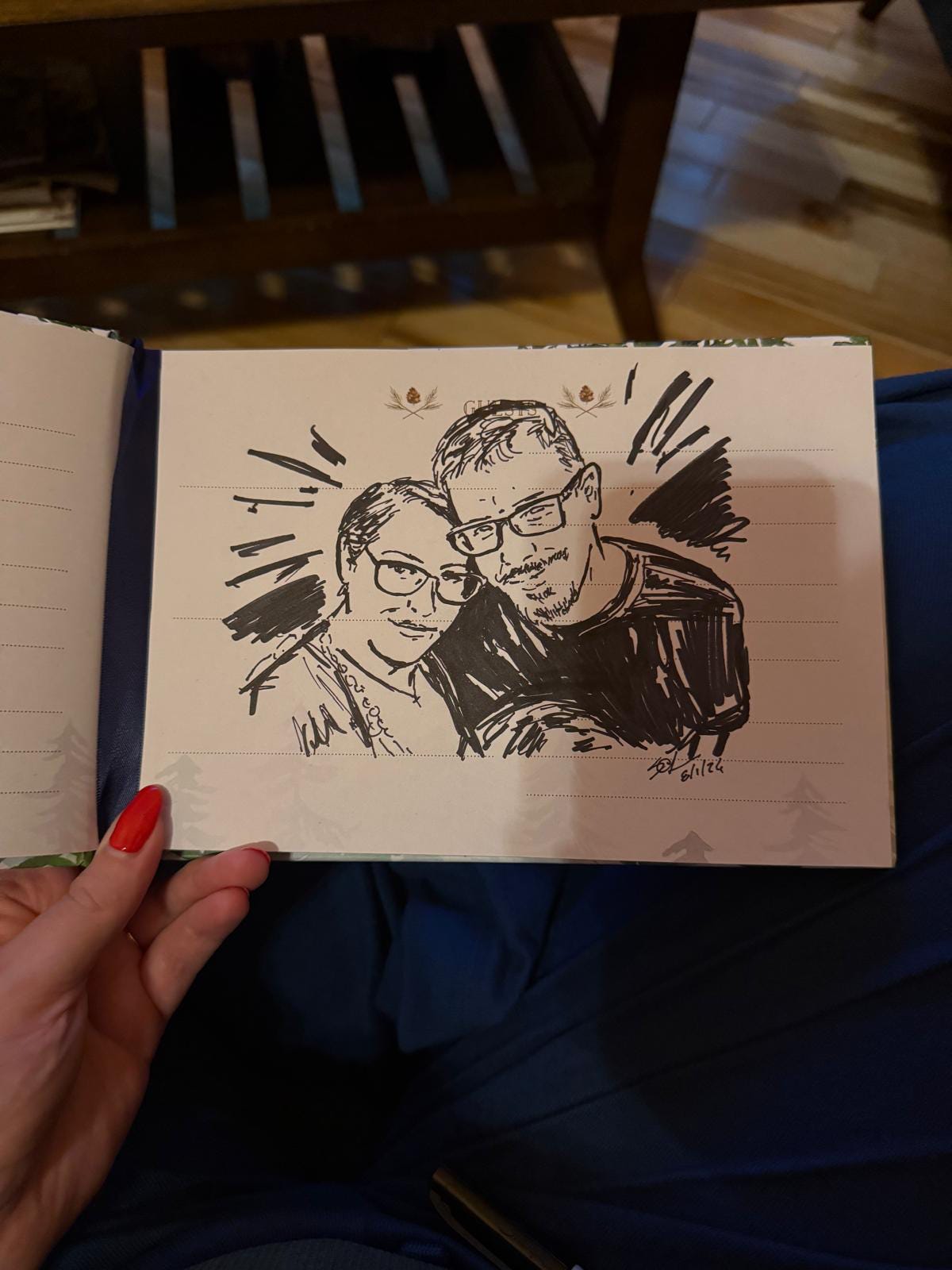
Steven Fain signed the guest book of our cabin as only he can.
Love this so much. I’ve had the delight of meeting a handful of Substackers in real life person as well, and it’s truly magical.
This is beautifully written. It's weird for me to see such things being said but know that I really appreciate it and I had the best time of my life while you were here.